


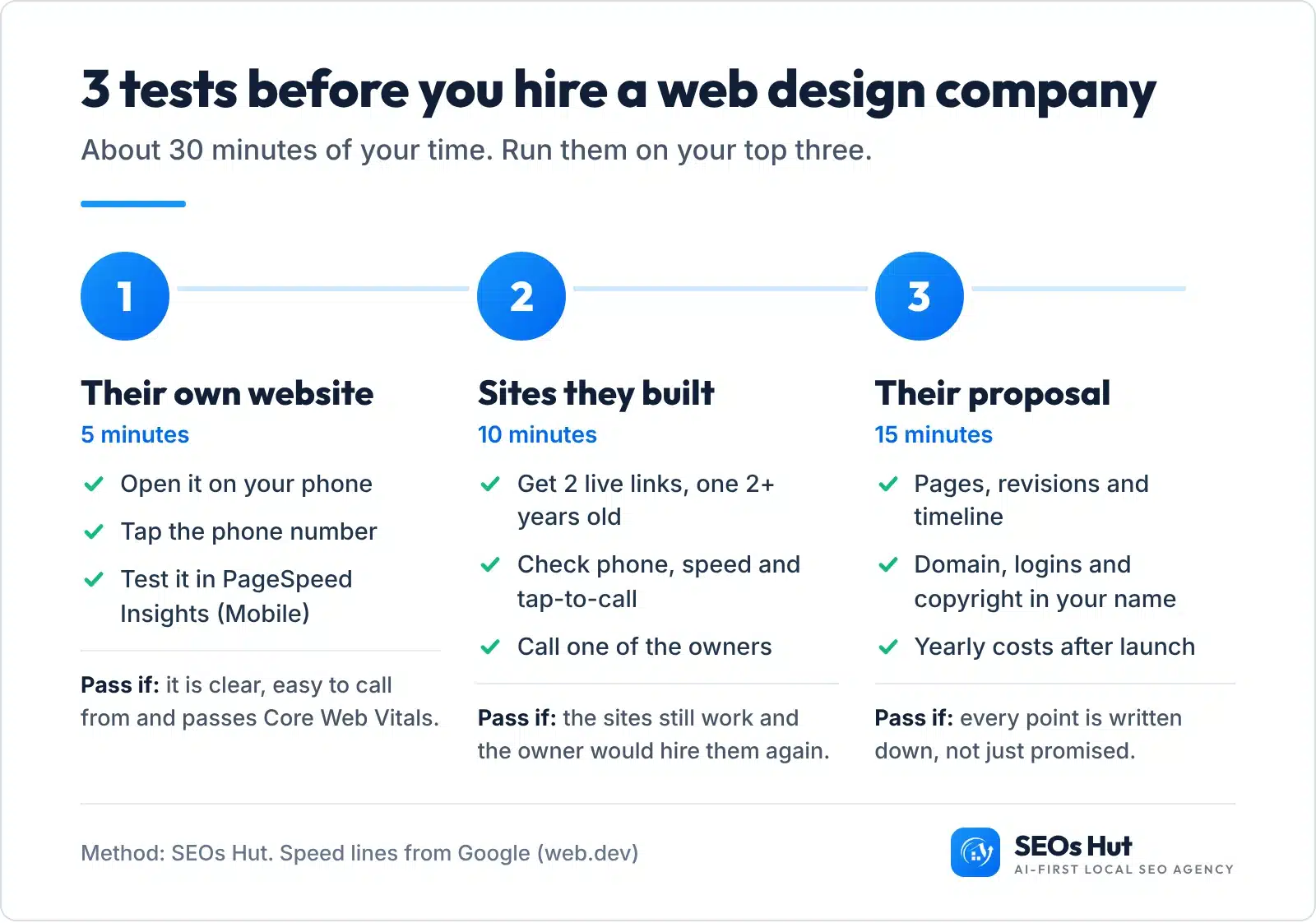
To choose a web design company, shortlist three, then run three tests before you sign: check their own website, check two live sites they built, and read their proposal line by line to see who will own the domain, the design and the logins. A good company passes all three in about 30 minutes of your time. A weak one usually fails the first.
That order matters because the sales call is the easiest part to fake. A fast, clear website, live work you can tap through on your phone and a proposal that answers every question in writing are much harder to fake. This guide shows you exactly how to run each test, what we found when we tested the websites of 49 Phoenix web design companies, and a free tool that reads a proposal with you and writes the follow-up email.
Before you call anyone: write a one-page brief
Ten minutes on a brief saves hours of calls, because every company will quote the same thing and you can compare like with like. Put five lines on one page:
- The one job of the site. Calls, bookings, quote requests or online sales. Pick one main job.
- The pages you need. Home, one page per service, one per town you serve, about, contact. A plumber with 6 services and 4 towns needs more than a 5-page site.
- Who writes the words and supplies the photos. You, them, or a mix. This changes the price more than design does.
- Your budget and deadline. A range is fine. Say if a launch date is fixed.
- Who will update it. If you want to change prices and photos yourself, say so now. It decides the platform.
Why the one job matters: your website is where your reviews send people. BrightLocal’s 2026 Local Consumer Review Survey found 54% of consumers are most likely to visit a business’s website after reading positive reviews. A pretty site that does not turn those visits into calls is an expensive brochure.
Choose for the long run, not just the launch. Clutch’s 2025 survey of small businesses found 81% have redesigned their website at least once, so you are also choosing who you can leave without losing anything. We come back to that in Test 3.
Where to find web design companies worth shortlisting
You only need three good candidates. The best places to find them:
- Sites you already like. Find a local business website that works well on your phone, scroll to the footer and look for a “website by” credit. Ask the owner if they would hire them again.
- Google Maps. Search “web design company” plus your city. Read the newest reviews, not just the star rating, and look for reviews that mention the finished site and support after launch.
- Directories and referrals. Clutch, your trade association or your accountant. Treat them as a list to test, not a verdict.
Skip anyone who found you first. Google’s own guide on hiring outside help says it plainly: “Be wary of SEO firms and web consultants or agencies that email you out of the blue.” The same page suggests the questions worth asking, including “How long have you been in business?” You can check that answer yourself with our free Domain Age Checker.
Test 1: Check the web design company’s own website
A web design company’s own site is the one project where nobody held them back: no client budget, no client opinions. If it is slow on a phone, hard to read or hard to contact them from, that is their standard. It takes five minutes:
- Open it on your phone. Can you see what they do, where they are and how to call them without zooming or hunting? Tap the phone number. Does it dial?
- Run it through PageSpeed Insights. Go to pagespeed.web.dev, paste their home page and keep the Mobile tab selected. If there is enough real-visitor data, the top box says whether the page passes the Core Web Vitals assessment. Our Core Web Vitals Checker runs the same test with a plain-English summary.
- Read the three numbers, not the score. Google’s “good” lines, from web.dev: the main content shows within 2.5 seconds (LCP), the page reacts to a tap within 200 milliseconds (INP), and the layout does not jump around (CLS of 0.1 or less).
- Look for proof, not claims. Real client names, live links to their work and case studies with numbers beat “award-winning” and stock photos.
What we found when we tested 49 Phoenix web design companies
To see how the companies selling websites build their own, we took the website link from every Google Business Profile in the Google Maps results for “web design company” in Phoenix, Arizona on 17 November 2026, and ran each home page once through Lighthouse, the lab test behind PageSpeed Insights, on its default mobile settings. 54 of the 60 listings had a website, and 49 of those loaded and produced a result.
The basics were mostly there. All 49 used HTTPS, 43 kept the layout steady while loading, and 41 scored 90 or more on Lighthouse’s SEO check. Speed was the weak spot. On a simulated mid-range phone, only 6 of 49 showed their main content within Google’s 2.5 second line, and 35 took longer than 4 seconds. The median site needed 5.7 seconds. Only 5 scored 90 or more for performance, and 24 scored under 50.
Readability was the other gap: 33 of 49 failed Lighthouse’s colour contrast check, which flags text that is hard to read against its background. Only 27 scored 90 or more for accessibility. You can download the full anonymous dataset (CSV) and check our working.

Two cautions. This is a lab test from one machine on one day, so it shows likely problems, not how real visitors experienced each site. And a slow agency site does not prove they build slow client sites. But if a company sells speed and mobile design, its own site is a fair first question. Ask them about it. A good company will have an answer.
Test 2: Check websites they built (the portfolio test)
Screenshots in a portfolio prove someone made a design. They do not prove the site still works, loads fast or brings the owner calls. Ask for two live addresses of sites they built for businesses like yours, including one that launched at least two years ago, then spend five minutes on each:

- It is live and theirs. The site loads, and the footer credit or the owner confirms they built it. Templates are fine; passing off someone else’s work is not.
- It works on a phone. Text is readable without zooming, buttons are easy to tap, nothing sits off the edge of the screen.
- Calling is one tap. For a local business the phone number should be a tap-to-call link near the top of every page.
- It loads fast. Run it through PageSpeed Insights on Mobile, exactly as in Test 1.
- Google can read it. Search the business name. Does the site show up, with a sensible title? Our free Schema Markup Analyzer shows whether the site tells Google its business name, address and hours in code (LocalBusiness schema).
Then do the one check most people skip: call or email one of those owners. Ask three things. Was it on time and on budget? Can you change text and photos yourself? Do they answer quickly after launch? Two minutes on the phone tells you more than any review.
Accessibility belongs in this test too. The US Department of Justice says the ADA’s requirements apply to the goods and services businesses offer “on the web”, and WebAIM’s 2026 scan of the top one million home pages found detectable WCAG 2 failures on 95.9% of them, an average of 56.1 errors per page. Ask which standard they build to. The current one is WCAG 2.2, and level AA is the usual target.
Test 3: Read the proposal line by line
Most website problems start as a missing line in a proposal: the domain registered in the agency’s name, no word on who owns the design, a hosting fee that doubles in year two, or “minor changes” that turn out to cost extra. The fix is simple. Get every important point in writing before you sign.
Use the free checker below. Tick only what the proposal actually says in writing, not what the salesperson told you. It shows what is missing and writes a polite email asking for it, ready to copy and send.
Prefer paper? Download the free one-page proposal checklist (PDF). No email needed. Print one per company and bring it to the calls.
Who owns your website? The keys you must hold
When you pay for a website, you expect to own it. Legally, that is not automatic, and this is where business owners get stuck when they want to leave. Here is what decides it.
The domain. Whoever is listed as the registrant controls it. ICANN’s transfer policy says “The Registered Name Holder is the only party that has the authority to approve or deny a transfer request”. If the agency registers your domain in its own name, it holds your web address. Ask for it in your name, with your email, from day one. Already have a site? Log in to your registrar (GoDaddy, Namecheap and so on) and check the registrant contact says your business.
The design and code. In the US, copyright normally belongs to whoever created the work. A commissioned website only counts as a “work made for hire” in narrow cases, and the US Copyright Office notes that “If a work fails to satisfy any of these requirements, it is not a work made for hire.” The Office also explains that a transfer of copyright “generally must be made in writing and signed by the owner”. So the safe line in a contract is a written transfer of the design, code and content to you when the final invoice is paid. Themes, plugins, fonts and stock photos are licensed, not owned, so ask for a list of them and who pays their renewals. (Outside the US the rules differ; the principle of getting it in writing does not. This is general information, not legal advice.)
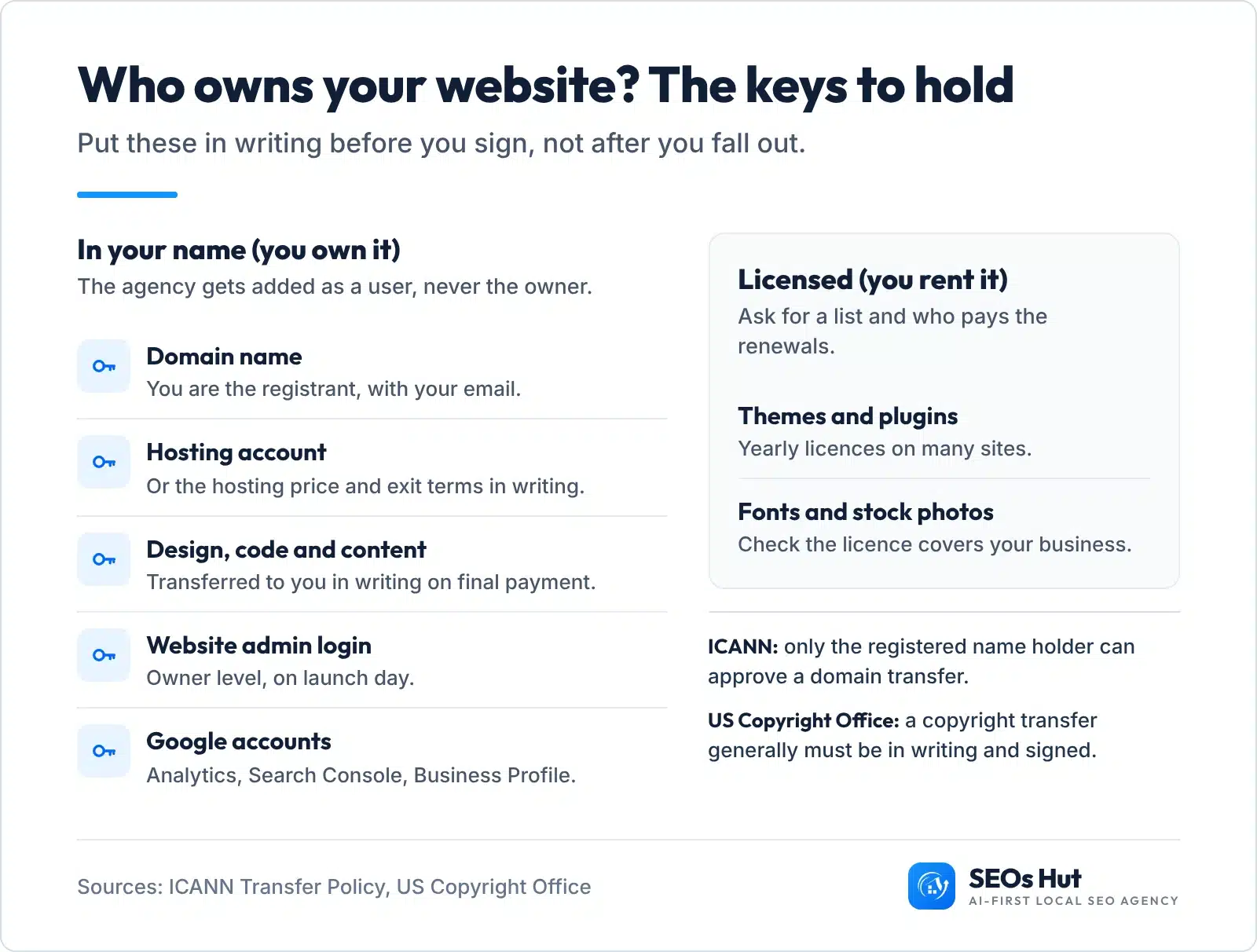
The accounts. Hosting, the website admin, Google Analytics, Search Console and your Google Business Profile should be in your name, with the agency added as a user. That way they work for you, and you can remove them in a minute if you part ways.
Questions to ask a web designer before hiring
You have already answered a lot of these by running the three tests. Use the calls for the questions only a person can answer:
- Who will actually design and build my site? The person on the call, an in-house team or a subcontractor? Any answer can be fine; a vague one is not.
- Can you show me examples of your previous work and share some success stories? That is Google’s own suggested question, word for word. Ask for numbers: calls, bookings, leads.
- Which platform will you use, and can I edit it myself? WordPress, Wix, Squarespace or custom. Ask for a five-minute demo of editing a page.
- What happens to my Google rankings when the old site is replaced? Listen for “we redirect every old page address to its new page”. If they look blank, keep looking. Our guide to redirect chains explains why this matters.
- What will I pay every year after launch? Domain, hosting, licences, maintenance. Get the year-two number, not just the build price.
- What does support look like after launch, and how fast do you reply? Ask what a typical small change costs.
- How will we measure success? A good answer names a number you care about, such as calls or form leads, and how it will be tracked.
Red flags when choosing a web design company
- Ranking guarantees. Google says it outright: “No one can guarantee a #1 ranking on Google.”
- Secrecy. Google again: “Be careful if a company is secretive or won’t clearly explain what they intend to do.” That includes refusing to say who builds the site or which platform it runs on.
- Your domain or hosting in their name, with no written plan to hand them over.
- No live work. Only screenshots, or links that no longer load.
- A price with no page list, no revision limit and no running costs. Vague quotes are where the extra bills come from.
- Full payment upfront for a project that takes weeks. Staged payments tied to milestones protect both sides.
How much does a web design company cost?
Prices vary too much for one honest number, because the page count, who writes the content and the features you need change the quote more than the company does. Two public reference points help you judge an hourly rate, checked on 17 November 2026:
- Freelancers: Upwork lists a median of $15 to $30 an hour for web designers on its platform.
- Employed professionals: the US Bureau of Labor Statistics puts the median pay of web developers and digital designers at $47.85 an hour ($99,520 a year, May 2025). That is pay, not an agency’s price: agencies add overheads, project management and support on top.
Whatever the quote, compare the total over two years, not the launch price. Our guide to what a website really costs breaks down the domain, hosting, renewal and licence fees line by line, with prices from each company’s own pages.
What we see in client work
The same three things decide whether a local website brings work: it is fast on a phone, calling or booking takes one tap, and Google can trust it. Our published case studies show it:
- Sugar & Wax Haven, Tempe. We designed and built a fast, mobile-first WordPress site with booking in two taps and the salon’s reviews on the first screen. The web design case study records that it became the foundation for 591% organic growth, and the SEO case study shows the salon moving from page 4 of Google to position #1 in 8 months.
- Awnings San Diego. The diagnosis on the case study page: “a website Google barely trusted”, with technical issues holding every page back. We repaired site speed and mobile rendering and added local business schema as part of the work that took the company from #54 to #1 in about 7 months.
- A1 Tire Shop, Sunrise FL. The new site puts a one-tap call button on every screen, because tire buyers are in a hurry and on a phone. The SEO case study records the shop moving from position #48 to #1 in about 6 months, with 770 phone calls from its Google Business Profile.
- Our own site. When we rebuilt seoshut.com, our website rebuild case study records page load going from 5.4s to 2.4s and the Lighthouse score from 54 to 98.
Every site is linked from our web design case studies, so you can run Test 2 on our work too. That is exactly what we would want you to do.
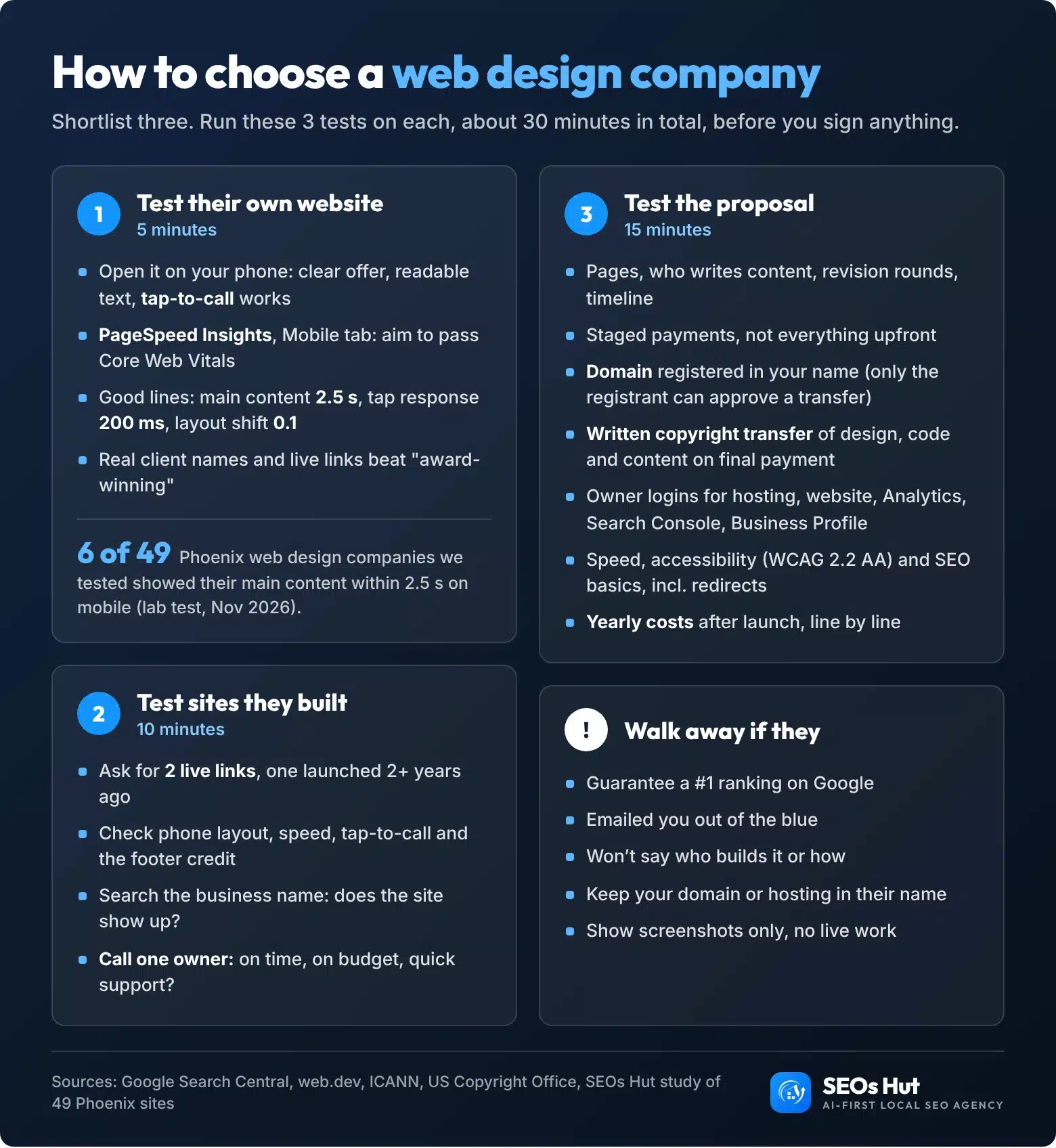
How to choose a web design company: cheat sheet
The whole method on one image. Save it, print it, or send it to whoever is helping you choose.
Want a team that passes all three tests? Our web design services put the domain, the logins and a written copyright transfer in your name from day one, and build every site to pass Core Web Vitals on mobile. Already have a site and not sure it is the problem? Start with a website audit and fix what is costing you calls first.
FAQs
How do I choose a web design company?
Shortlist three companies, then test them. Check their own website on your phone and in PageSpeed Insights, check two live sites they built for businesses like yours, and read the proposal for ownership, running costs and scope. Pick the one that passes all three and answers every question in writing, not the cheapest or the best talker.
Should I choose a freelancer or a web design agency?
Choose a freelancer for a small, simple site when you can wait for one person’s schedule, and an agency when you need several skills such as design, writing, SEO and ongoing support, or a fixed launch date. Run the same three tests either way. The ownership rules are identical: domain, logins and a written copyright transfer in your name.
Who owns my website when a web designer builds it?
Not automatically you. In the US the creator normally owns the copyright unless there is a written, signed transfer, and only the registrant listed on a domain can approve its transfer. Ask for the domain in your name, owner-level logins and a written transfer of the design, code and content on final payment. This is general information, not legal advice.
What should a web design proposal include?
A good proposal lists every page, who writes the content, the revision rounds, a timeline, the payment stages, who owns the domain, hosting, design and logins, speed and accessibility targets, SEO basics such as redirects from old pages, and the yearly running costs after launch. Our free proposal checker covers 18 items and writes the email for anything missing.
How long does it take to build a website for a small business?
It depends mostly on content, not code. A small site is quick to build once the words and photos are ready; waiting for them is what usually delays launch. Ask each company for a written timeline with milestones and what happens if either side is late, and have your brief, logo and photos ready before the project starts.
Sources
- Google Search Central, Do you need an SEO? (updated 5 June 2026)
- web.dev, Web Vitals (updated 31 October 2024)
- Clutch, State of Small Business Websites 2025
- BrightLocal, Local Consumer Review Survey 2026
- US Copyright Office, Circular 9: Works Made for Hire and Circular 1: Copyright Basics
- ICANN, Transfer Policy
- US Department of Justice, Guidance on Web Accessibility and the ADA (18 March 2022)
- WebAIM, The WebAIM Million (2026 report)
- W3C, WCAG 2.2 is a W3C Recommendation
- Upwork, How much does it cost to hire a web designer
- US Bureau of Labor Statistics, Web Developers and Digital Designers
- SEOs Hut study: Lighthouse mobile test of 49 Phoenix web design company websites, 17 November 2026 (anonymous data, CSV)