


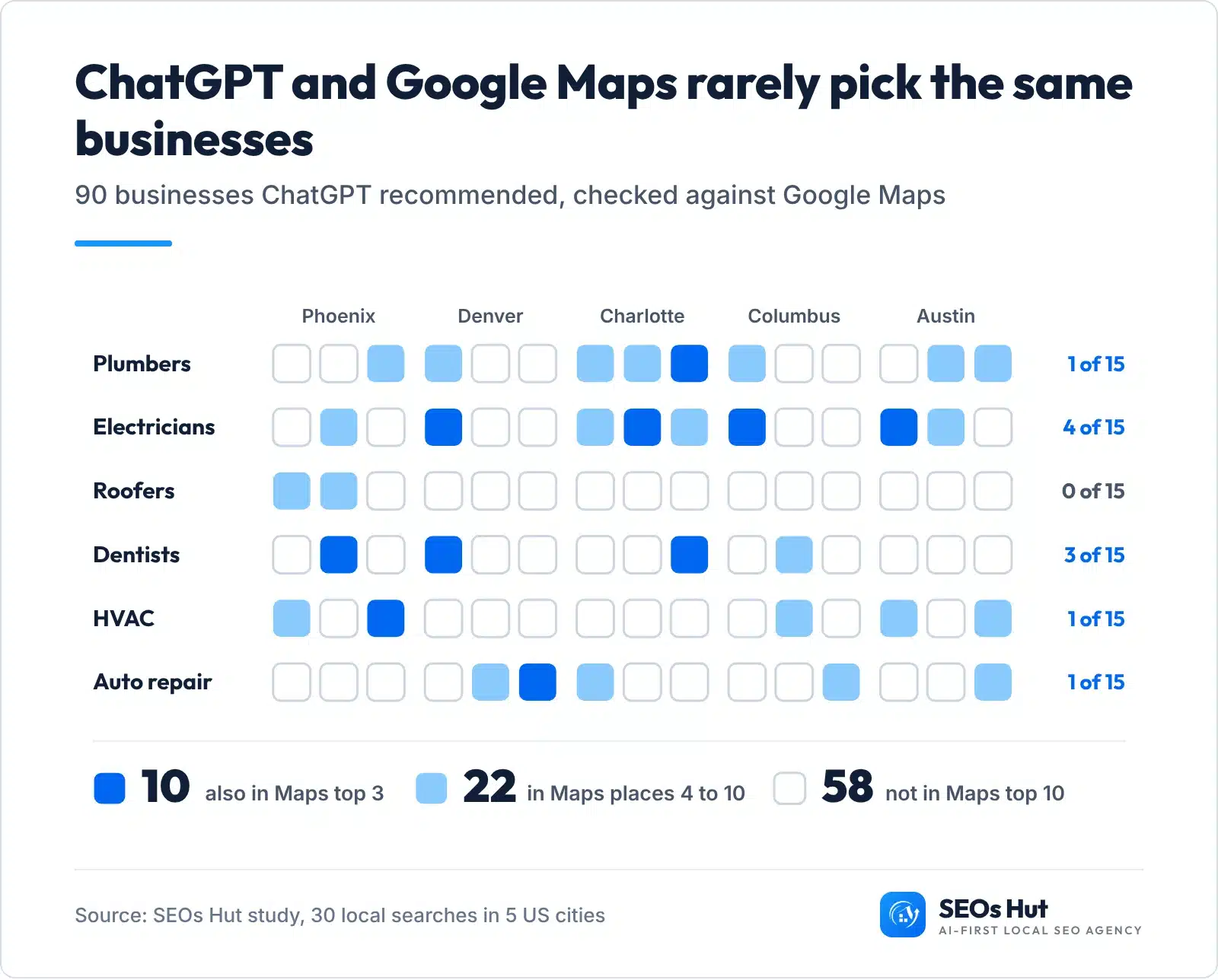
No, local SEO is not dead. It now has two scoreboards: Google Maps and AI answers, and they often pick different businesses. When we asked ChatGPT for the best local businesses in 30 searches across five US cities on 4 November 2026, only 10 of its 90 picks were also in Google’s Map Pack top 3.
So the work did not stop mattering. It got wider. Below you will find what changed, what our test found, what is truly dead, what still works, and a free check that shows where your business stands on both scoreboards in about 10 minutes.
Jump to: What changed · Our ChatGPT test · Why the picks differ · What is dead · What still works · Check your business · FAQs
What changed in local search (and what didn’t)
Two things happened at once. Google started answering more questions itself, and customers started asking AI assistants for recommendations. Both cut clicks to websites. Neither stopped people from looking for a plumber, a dentist or a roofer.
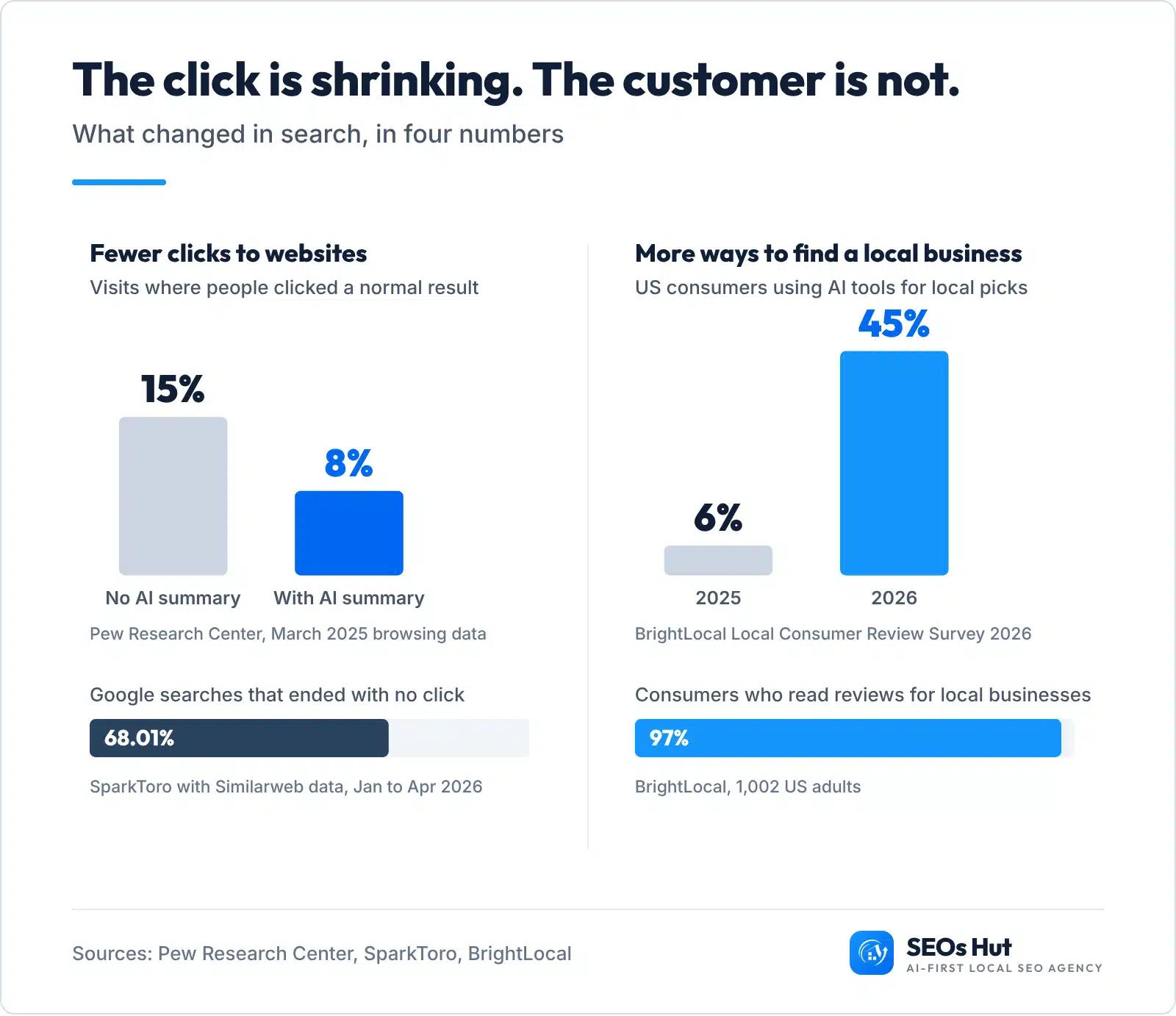
Here is the part that sounds scary. In Pew Research Center’s March 2025 browsing data, people clicked a normal result in 8% of Google visits that showed an AI summary, against 15% when there was none (Pew Research Center). SparkToro, using Similarweb data, found that 68.01% of Google searches in the first four months of 2026 ended without a click (SparkToro).
And here is the part people skip. The same SparkToro report says some categories still benefit from SEO, including branded searches, local businesses, and high-intent transactional or tactical queries.
A person who needs a plumber tonight still has to pick one.
They are just picking in more places now:
- Google Maps is used by more than 2 billion people a month and holds information on over 300 million places, according to Google (Google, Google Maps blog).
- AI in Google Search is huge: Google says AI Overviews has over 2.5 billion monthly active users and AI Mode passed 1 billion (Google I/O 2026). For local spots, Google says AI Mode shows
info like ratings, reviews, and opening hours
(Google). - AI assistants jumped fastest. In BrightLocal’s 2026 survey of 1,002 US adults, use of ChatGPT and other AI tools for local recommendations rose from 6% to 45% in a year, and 31% had used ChatGPT for business recommendations (BrightLocal, BrightLocal).
- Google is still the front door. StatCounter puts Google at 85.45% of US search in October 2026 (StatCounter).
Figures checked 4 Nov 2026. We re-check them every quarter.
So the real question is not whether local SEO is dead. It is whether you show up when the customer asks AI instead of Google. We tested that.
We asked ChatGPT for 90 local businesses. Here is what came back
The short version: ChatGPT and Google Maps mostly recommend different businesses, and ChatGPT builds its answer from best-of lists and review counts, not from the businesses’ own websites.
How we tested. On 4 November 2026 we asked ChatGPT (with web search on, set to each city) Who is the best [trade] in [city]? Give me 3 options.
for six trades (plumber, electrician, roofer, dentist, HVAC company, auto repair shop) in five cities (Phoenix, Denver, Charlotte, Columbus, Austin). That is 30 questions and 90 named businesses. For each question we pulled the Google Maps results for the same search in the same city and checked whether ChatGPT’s picks were in the Maps top 3 and top 10.
- 10 of 90 ChatGPT picks (11%) were also in the Google Maps top 3.
- 32 of 90 (36%) were somewhere in the Maps top 10. The other 58 were not in the top 10 at all.
- Roofers: 0 of 15 picks were in the Maps top 3. Electricians matched best, with 4 of 15.
- Every one of the 30 answers quoted star ratings or review counts. Half named Google reviews or a Google rating.
| Trade | Picks in Maps top 3 | Picks in Maps top 10 |
|---|---|---|
| Plumbers | 1 of 15 | 8 of 15 |
| Electricians | 4 of 15 | 8 of 15 |
| Roofers | 0 of 15 | 2 of 15 |
| Dentists | 3 of 15 | 4 of 15 |
| HVAC companies | 1 of 15 | 5 of 15 |
| Auto repair shops | 1 of 15 | 5 of 15 |
Then we looked at what ChatGPT read. Its 30 answers cited 67 different pages.

Two out of three cited pages were best-of lists and ranking sites (the “10 best plumbers in Phoenix” kind of page). About a quarter were directories and review platforms. Not one answer cited the website of a business it recommended.
How this fits bigger studies. Our test is small and uses one type of question, so read it as a snapshot. Bigger studies point the same way on lists and reviews but differ on websites. Whitespark’s 2026 Local Search Ranking Factors survey of 47 experts made Presence of Business on Expert Curated Best of and Similar Lists
the top factor for AI search visibility (Whitespark). BrightLocal’s study of 200,000 local AI searches found business websites made up 42% of all citations, and that Google Maps mentioned a tracked business in 66% of searches against 32% to 38% for AI surfaces (BrightLocal). Our reading: for “best [trade] in [city]” questions, ChatGPT leans on lists; for other questions, your own site matters more.
Want the numbers behind this? Download the study data (CSV). Method: one answer per question, Maps checked from each city’s centre, ads excluded, names matched by hand-checked rules. AI answers change between runs.
Why Google Maps and ChatGPT pick different businesses
Because they keep score in different ways. Google says local results are mainly based on relevance, distance, and popularity
, and that More reviews and positive ratings can help your business’s local ranking.
(Google Business Profile Help). Distance is the big one: Maps favours businesses close to the person searching.

ChatGPT works differently. OpenAI says ChatGPT search uses third-party search providers and may share queries with providers such as Bing
, and it uses a rough location from your IP address (OpenAI). In our test it then trusted pages that had already compared businesses for it: ranking lists and review platforms. A business with great reviews that no list mentions can win the map and still be missing from the AI answer. The reverse happens too.
That is why “is local SEO dead?” is the wrong frame. One scoreboard did not replace the other. You now need to show up on both.
What is dead in local SEO
Some old habits really are finished. If your agency still sells any of these, ask why.
- Buying or filtering reviews. Google calls reviews given in exchange for discounts or freebies
fake & misleading content
(Google), and bans asking only happy customers (Google). Google says it blocked or removed more than 240 million policy-breaking reviews from 2024 (Google). - Fake addresses and extra profiles. The same Google report says it removed or blocked more than 12 million fake Business Profiles.
- Paying for a better map position. Google is blunt:
There’s no way to request or pay for a better local ranking on Google.
(Ads are a separate thing.) - Judging success by website clicks alone. With most searches ending without a click, calls, direction requests and bookings from your profile tell you more. See how to read them in our Google Business Profile optimization guide.
- Being findable in only one place. In our test, the page that decided the AI answer was usually someone else’s list, not your site and not your Google profile.
What still works: a plan for both scoreboards
The basics still win the map, and a few new habits win the AI answer. Do them in this order.
Step 1. Win the Google Maps scoreboard
- Pick the right primary category. Whitespark’s experts rank the primary Google Business Profile category as the number one Map Pack factor (score 227). Choose the category that names your main money service, not a broad one.
- Get steady, real reviews. In BrightLocal’s 2026 survey, 97% of consumers read reviews for local businesses and 47% will not use a business with fewer than 20. Make asking easy with a free Google review link.
- Fill in every field. Google says customers are 2.7 times more likely to consider a business reputable when they find a complete Business Profile (Google). Hours, services, photos, booking link, all of it. Our Google Business Profile Audit lists what is missing.
- Claim Apple and Bing too. Apple Business is free and shows your place card across Apple Maps, Safari and Spotlight (Apple). Bing Places is free and feeds Bing search and Bing Maps (Microsoft Bing), and Bing is one of the providers ChatGPT search can use.
- Track your map position across your area, not just from your shop. A local rank grid shows where you drop out of the top 3.
Step 2. Win the AI answer scoreboard
- Get onto the lists AI reads. Ask ChatGPT the question your customers ask, open every page it cites, and note the lists you are missing from. Many lists are built from public reviews and ratings, so Step 1 feeds this step. Our AI Citation Gap Finder shows which sites AI cites for your topic.
- Give each main service its own page. Whitespark’s experts rank
Dedicated Page for Each Service
second for AI visibility (score 170). One page for drain cleaning, one for water heaters, with your city, prices or price ranges, and real jobs. - Keep your reviews alive on more than Google. A quarter of the pages ChatGPT cited in our test were directories and review platforms. Pick the two or three that matter in your trade and keep your name, phone and hours the same everywhere. A NAP consistency check finds the mismatches.
- Let AI search bots read your site. OpenAI says sites that opt out of its OAI-SearchBot crawler
will not be shown in ChatGPT search answers
(OpenAI). Check yours with our AI Crawler Access Checker.
Check your business on both scoreboards in 10 minutes
Type your trade and city, run the searches, then tick what is true. You get a score for each scoreboard and your next three fixes. Nothing is sent anywhere; it all runs in your browser.
Two-scoreboard check
Free, no signup. Works on your phone.
1. Run these searches the way a customer would
2. Tick what is true for your business
Google Maps scoreboard
AI answer scoreboard
Prefer paper? Download the one-page two-scoreboard worksheet (PDF). Free, no email needed.
Want the AI side checked for you? Our free AI Recommendation Checker asks ChatGPT, Gemini, Perplexity, Claude and Google’s AI Mode your customers’ question live and shows who they name instead of you.
What we see in client work
Sugar & Wax Haven, a body sugaring salon in Tempe, is the clearest example we have of winning both scoreboards at once. From the live case study: In 8 months, we took a Tempe body sugaring salon from page 4 of Google to position #1.
On the profile side, We grew reviews from 67 to 309
. On the AI side the case study counts 282 AI Overview citations, 24 in ChatGPT, 23 in Copilot and 14 in Gemini, and an unedited ChatGPT answer that ranks the salon #1 of 5
with its rating and review count quoted inside the answer.
The point for you: the reviews that lifted the map ranking are the same reviews the AI answer quoted. Read the full Tempe salon case study.
Is local SEO still worth it for a small business?
Yes, if customers search for what you do in your area, and almost every trade has that. Google still handles most US searches, nearly everyone reads reviews before choosing, and AI answers now repeat those same reviews and ratings. What changed is where the work pays off: more of it shows up as calls and direction requests than as website visits.
To put a number on it for your own business, use the worth-it calculator in our guide to the benefits of local SEO. It also covers our earlier test where the Map Pack showed above every website in 39 of 40 local searches.
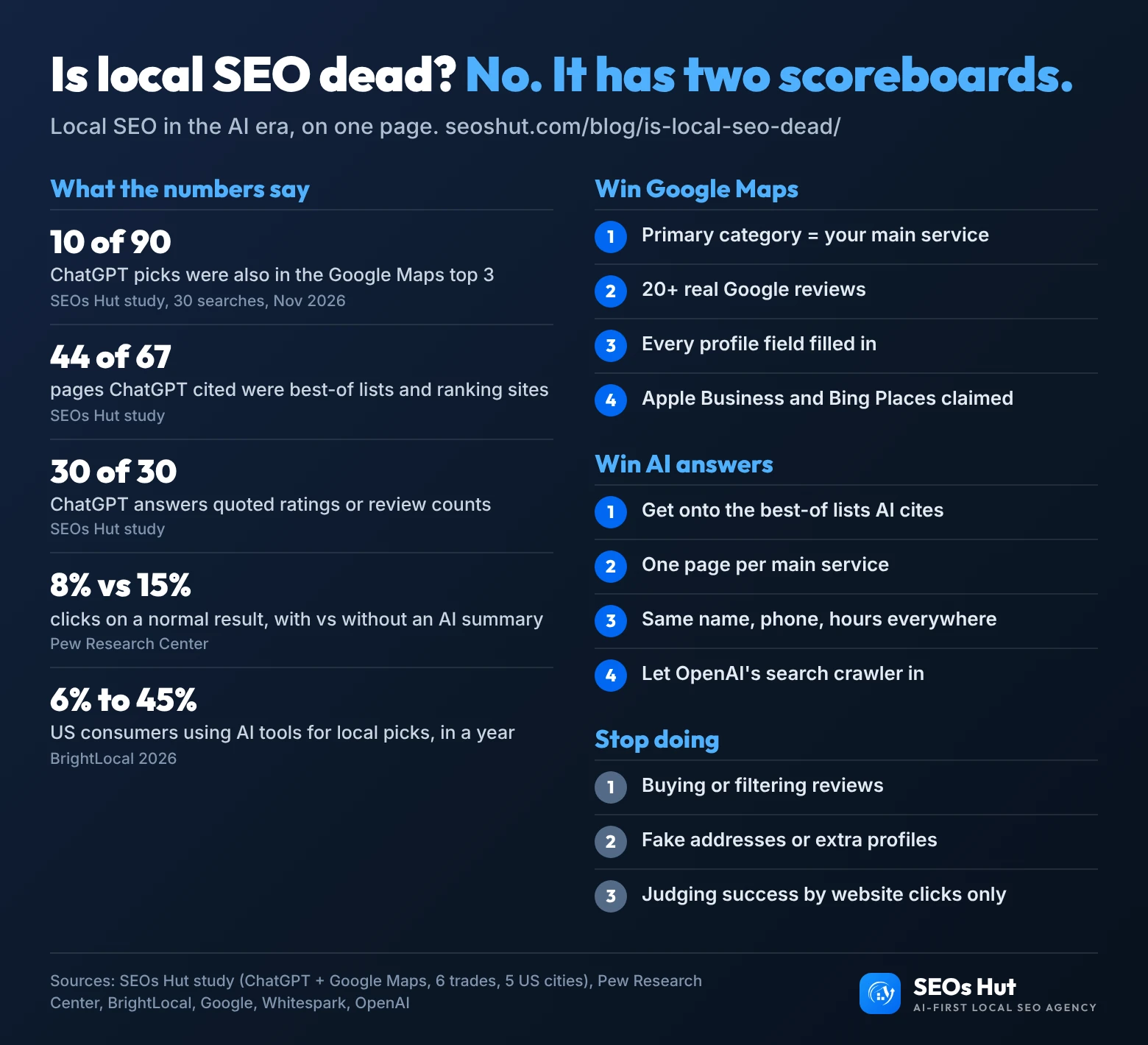
Local SEO in the AI era: the cheat sheet
Everything above on one page. Save it, print it, or share it with your team.
FAQs
Is local SEO dead in 2026?
No. Local SEO is not dead, but it now covers two scoreboards: Google Maps and AI answers. Google says local results still depend on relevance, distance and popularity, and SparkToro notes local businesses still benefit from search. In our test, only 10 of 90 ChatGPT picks were also in the Maps top 3, so you need both.
Will AI replace local SEO?
No. AI changes where customers ask, not what they need. AI assistants still have to choose real businesses, and in our test every ChatGPT answer quoted ratings or review counts and two thirds of its sources were best-of lists. The signals local SEO builds, like reviews, listings and service pages, are the raw material AI answers use.
Does ChatGPT use Google reviews to recommend businesses?
Sometimes. In our 30-answer test, half of ChatGPT’s answers named Google reviews or a Google rating, and all 30 quoted ratings or review counts from some source. OpenAI says ChatGPT search uses third-party search providers such as Bing, so keep reviews strong on Google and on the platforms that matter in your trade.
Is a Google Business Profile still worth it?
Yes. It is free, it powers your place in Google Maps, and Google says customers are 2.7 times more likely to consider a business reputable when they find a complete profile. Google also says AI Mode shows ratings, reviews and opening hours for local places, so the same profile feeds Google’s AI answers.
How do I get my business recommended by ChatGPT?
Ask ChatGPT the question your customers ask, see which pages it cites, and get onto the best-of lists and review platforms you are missing from. Then give each main service its own page, keep reviews coming, and make sure your site does not block OpenAI’s search crawler. Re-check monthly, because answers change.
Want both scoreboards handled for you?
We are an AI-first local SEO agency: we run Google Business Profiles, reviews, citations and service pages so you win the map, and we track who AI recommends so you win the answer too. See our local SEO services or, if AI answers are the gap, our AI SEO services.
Sources
- SEOs Hut study: 30 ChatGPT answers and 30 Google Maps searches, 6 trades in 5 US cities, 4 Nov 2026 (data).
- Google Business Profile Help: How to improve your local ranking on Google; complete Business Profile; review incentives.
- Google Maps user contributed content policy: review rules for merchants.
- Google: I/O 2026 keynote (19 May 2026); AI Mode updates (1 May 2025); fake reviews report (7 Apr 2025); 20 years of Google Maps (6 Feb 2025); Ask Maps (12 Mar 2026).
- Pew Research Center: Google users are less likely to click on links when an AI summary appears (22 Jul 2025).
- SparkToro: In 2026, less than one third of Google searches still send a click (8 Jun 2026).
- BrightLocal: Local Consumer Review Survey 2026; AI trust research (Mar 2026); Local AI visibility study (Sep 2026).
- Whitespark: Local Search Ranking Factors 2026.
- OpenAI: ChatGPT search help; OpenAI crawlers.
- StatCounter: US search engine market share, October 2026.
- Apple: Introducing Apple Business. Microsoft Bing: Bing Places for Business.